
Hearing Aid Specialist: From Hearing Test to Personalized Hearing Solutions
Hearing difficulty can gradually affect conversations, work, family interactions and everyday activities. A hearing aid specialist can help people understand their hearing needs through professional assessment and guide them toward suitable hearing solutions.
The process does not begin with simply buying hearing aids. It starts with a hearing test, understanding the level of hearing loss, discussing lifestyle needs and selecting a suitable solution. This blog explains the role of a specialist, hearing assessment, hearing aid consultation, different hearing aid types, fitting, adjustment and ongoing professional hearing care.
Role of a Hearing Aid Specialist in Professional Hearing Care
A hearing aid specialist helps patients understand their hearing needs and the available hearing solutions. Their role can extend from initial assessment and consultation to hearing aid fitting and follow-up support.
A professional hearing care journey may include:
- Understanding the patient's hearing concerns
- Recommending an appropriate hearing assessment test
- Reviewing hearing test results
- Discussing suitable hearing aids
- Providing hearing aid consultation
- Supporting hearing aid fitting and adjustment
- Providing guidance about hearing aid care and maintenance
- Supporting follow-up and fine-tuning
The right solution can vary depending on hearing loss, age, communication requirements, lifestyle and personal preferences.
Hearing Loss Signs and the Need for Professional Assessment
Hearing loss does not always happen suddenly. Some people gradually notice changes in their ability to understand speech or follow conversations.
Common signs may include:
- Frequently asking people to repeat themselves
- Difficulty understanding conversations in noisy places
- Increasing TV or phone volume
- Missing parts of conversations
- Difficulty hearing people from another room
- Feeling that people are speaking unclearly
- Difficulty following telephone conversations
- Ringing or buzzing sounds in the ears
If these changes continue, a professional hearing loss assessment can help determine whether further evaluation or hearing support may be appropriate.
For children and newborns, hearing concerns can require special attention. Early evaluation can help identify possible hearing difficulties and support appropriate next steps.
Hearing Tests and Hearing Loss Assessment
A hearing test is an important part of understanding hearing health. A hearing test specialist can conduct or guide appropriate hearing assessments and explain the results.
The assessment may help determine:
- Whether hearing loss is present
- The degree of hearing difficulty
- Whether both ears are affected
- How hearing changes across different frequencies
- Whether speech understanding may be affected
- What type of hearing support may be appropriate
Hearing Assessment Process
| Stage | What It Covers |
|---|---|
|
Initial consultation |
Discussing hearing concerns and listening difficulties |
|
Hearing assessment |
Evaluating hearing ability |
|
Results review |
Understanding the findings |
|
Hearing needs |
Considering communication and lifestyle requirements |
|
Recommendation |
Discussing suitable hearing solutions |
|
Follow-up |
Monitoring and adjusting the selected solution |
Terms such as assessment of hearing impairment, assessment hearing loss and hearing assessment may refer to different aspects of evaluating hearing ability. A qualified professional can explain which assessment is appropriate for an individual.
Hearing Assessment for Children and Newborns
Hearing care is not limited to adults. Children and newborns may also require hearing assessment when there are concerns about their response to sounds or communication development.
A hearing assessment child may be considered when parents notice concerns such as:
- Limited response to voices or sounds
- Difficulty following spoken instructions
- Delayed speech or communication
- Frequently needing repetition
- Difficulty hearing in classroom environments
Hearing assessment in newborn care can help identify hearing concerns at an early stage. Parents who notice possible hearing difficulties should discuss them with an appropriate hearing professional.
Early attention can be particularly important because hearing and communication development are closely connected during childhood.
Personalized Hearing Aid Consultation and Recommendations
After hearing assessment, the next stage may be a hearing aid consultation. This is where the specialist considers the person's hearing results alongside their everyday needs.
A personalized recommendation may consider:
- Hearing loss level
- Age
- Lifestyle
- Work environment
- Communication requirements
- Comfort preferences
- Hearing aid style
- Technology requirements
- Connectivity preferences
- Budget
The goal is not simply to select the most expensive or feature-rich device. Instead, the hearing aid should be appropriate for the individual's hearing needs and daily routine.
This personalized approach can make the process easier for first-time users who may feel confused by the number of hearing aid options available.
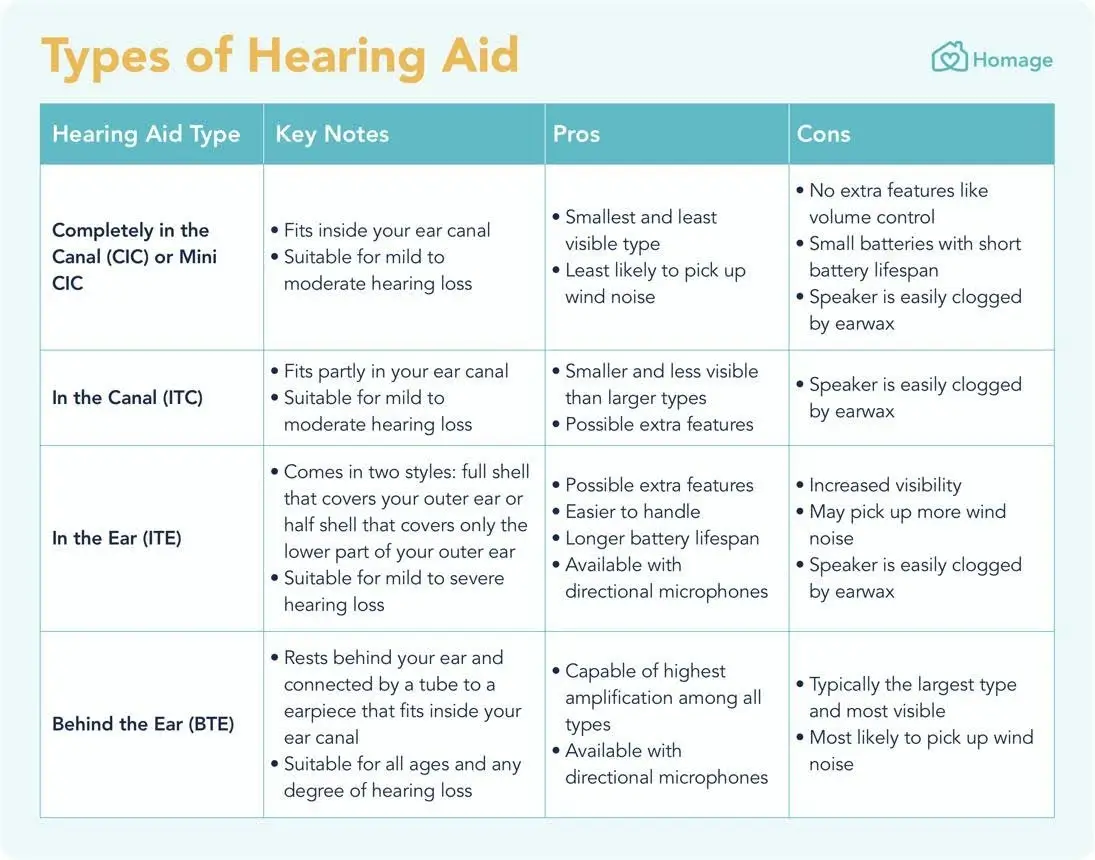
Types of Hearing Aids and Modern Hearing Technology
Modern hearing aids are available in different designs and technology levels. The appropriate type depends on hearing requirements, ear anatomy, lifestyle and professional recommendation.
Common options include:
- Digital hearing aids
- BTE hearing aids
- RIC hearing aids
- CIC hearing aids
- ITC hearing aids
- Bluetooth hearing aids
- Wireless Bluetooth hearing aids
- Rechargeable hearing aids
Hearing Aid Type Comparison
| Hearing Aid Type | General Characteristics |
|---|---|
|
BTE Digital Hearing Aid |
Sits behind the ear and connects to an ear-level component |
|
RIC Hearing Aids |
Receiver is positioned closer to or inside the ear canal |
|
CIC Hearing Aids |
Small in-the-canal style designed for a more discreet appearance |
|
ITC Hearing Aid |
Fits partly inside the ear canal |
|
Bluetooth Hearing Aids |
Can offer wireless connectivity with compatible devices |
|
Rechargeable Hearing Aids |
Designed for convenient daily charging |
Technology should be selected based on individual requirements rather than choosing a device solely because it has more features.
Bluetooth, BTE, RIC, CIC and ITC Hearing Aid Options
Different hearing aid styles serve different needs. Bluetooth hearing aids may be useful for people who want wireless connectivity with compatible smartphones or other devices.
Some users may also explore Signia Bluetooth hearing aids or other wireless hearing aid solutions depending on availability and professional recommendations.
For people considering a BTE digital hearing aid, the behind-the-ear design can offer practical options for different levels of hearing needs. RIC hearing aids, CIC hearing aids and ITC hearing aid styles provide alternative designs.
A hearing specialist can explain the differences between these options and help narrow the choices according to hearing test results, comfort and lifestyle.
Hearing Aid Fitting and Adjustment
Choosing a hearing aid is only one part of the process. Proper hearing aid fitting helps ensure that the selected device is appropriately positioned and configured for the user.
The fitting process may include:
- Checking physical comfort
- Initial programming
- Adjusting sound levels
- Setting appropriate amplification
- Checking speech clarity
- Making comfort-related adjustments
- Fine-tuning based on feedback
Hearing aid adjustment may also be needed after the user has spent some time wearing the device. Everyday listening experiences can provide useful feedback for further personalization.
First-time users may need a period of adjustment as they become familiar with amplified sounds and new listening experiences.
Choosing the Right Hearing Aid Specialist in Vapi
When searching for a hearing aid specialist in Vapi, patients should consider more than just the availability of hearing aids.
Useful factors include:
- Availability of professional hearing assessment
- Hearing aid consultation
- Range of hearing aid options
- Proper fitting and programming
- Adjustment and fine-tuning support
- Maintenance and aftercare
- Accessibility for follow-up visits
- Clear explanation of available solutions
For local patients, choosing a professional hearing care provider can make the complete process—from hearing assessment to ongoing hearing aid support—more convenient.
Book Your Hearing Consultation with Unity Hearing Care.
Professional Hearing Care and Ongoing Hearing Aid Support
Hearing care does not necessarily end after receiving hearing aids. Regular support can help users maintain their devices and address changes in comfort or listening requirements.
Ongoing support may include:
- Hearing aid cleaning guidance
- Routine maintenance
- Hearing aid adjustment
- Programming changes
- Technical support
- Repair assistance
- Follow-up consultation
- General hearing care guidance
This continued support is particularly useful for first-time hearing aid users who may need assistance while adapting to their devices.
FAQs
1. What does a hearing aid specialist do?
A hearing aid specialist helps with hearing assessment, hearing aid consultation, device selection, fitting, adjustment and ongoing hearing aid support
2. How do I find a hearing aid specialist near me?
Search for a professional hearing care provider offering hearing tests, consultation, hearing aid fitting and aftercare in your local area
3. What should I expect during a hearing aid consultation?
The consultation generally includes discussion of your hearing concerns, review of hearing assessment results, lifestyle needs and suitable hearing aid options
4. What types of hearing aids are available?
Common types include BTE, RIC, CIC and ITC hearing aids, along with digital, rechargeable and Bluetooth-enabled options.
5. How is the right hearing aid selected?
The choice can depend on hearing test results, hearing loss level, lifestyle, communication needs, comfort, technology preferences and professional recommendations.
